


Nigerian mining company Promethean Resources has announced partnerships with three United States companies covering precision mining equipment, renewable energy and technology-enabled security, as Nigeria seeks to turn its new minerals cooperation framework with Washington into commercial projects.
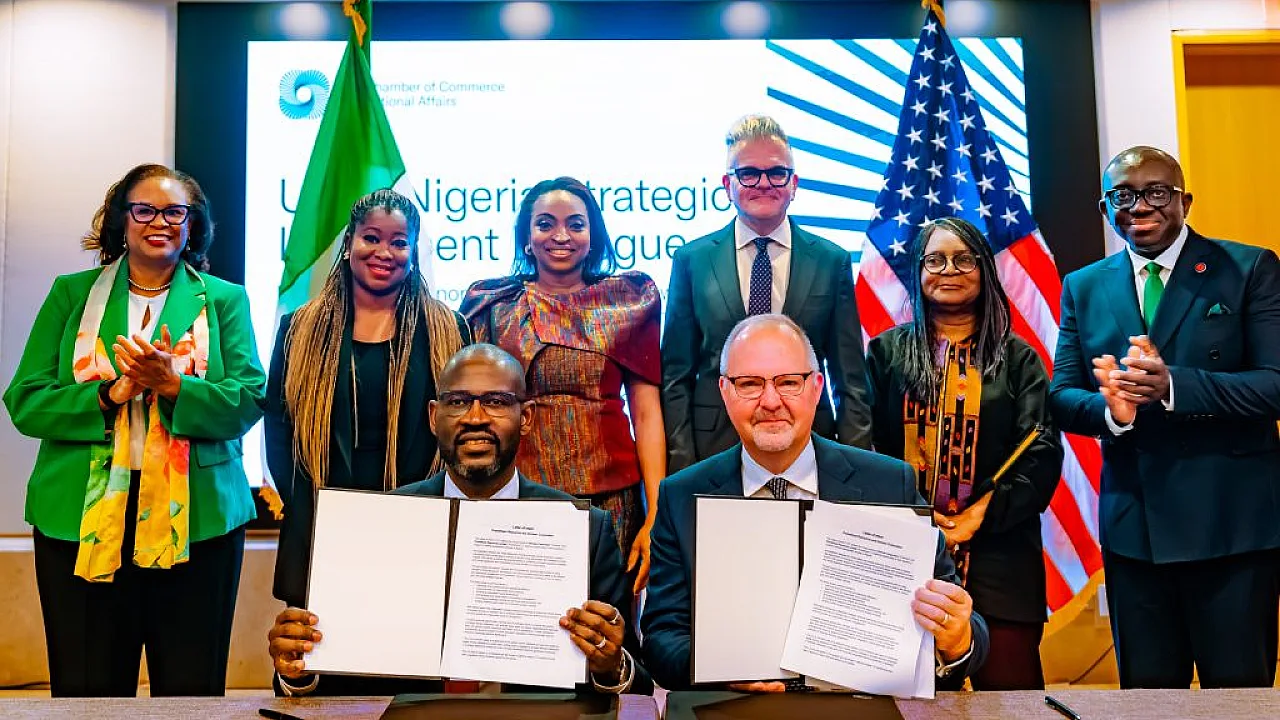
The arrangements with Vermeer Corporation, Renewvia Energy and Terra Industries were unveiled during the Nigeria-US Strategic Investment Dialogue in New York, held alongside the 81st United Nations General Assembly.
The three partnerships address different challenges facing mining operations in Nigeria: access to modern machinery, reliable electricity and security at remote sites.
Promethean and Vermeer Corporation are exploring the deployment of precision mining equipment across mineral projects involving iron ore, tin, lithium and gold.
Vermeer manufactures equipment used in surface mining and other heavy industrial operations, including machines designed for controlled rock excavation and mineral extraction.
The proposed collaboration is expected to examine how such equipment can be deployed across Promethean's mining portfolio, with attention to operational efficiency, processing and workforce development.
The Vermeer arrangement remains exploratory, rather than evidence that equipment has already been deployed to Nigerian mines.
The second partnership involves Renewvia Energy, a US-based renewable energy company.
Renewvia said it had signed a strategic partnership with Promethean to develop solar power, battery storage and mini-grid systems for mining and mineral-processing operations.
The power systems are intended not only to support industrial activity at mining locations but also, where feasible, extend electricity access to communities around the sites.
That is significant because mining projects can be located far from reliable electricity infrastructure, leaving operators dependent on diesel generators or costly alternatives.
Promethean and Renewvia are expected to assess priority locations before developing energy systems suited to individual mining and processing sites.
Renewvia Chief Executive George Truett Jarrard and Promethean Managing Director Demola Gbadegesin signed the agreement during the investment dialogue.
A third partnership centres on security.
Promethean has entered into an arrangement with Terra Industries for the deployment of technology-enabled surveillance and security systems around mining and mineral-processing sites.
The proposed systems include autonomous surveillance infrastructure, unmanned aerial systems and Terra's ArtemisOS platform, which is designed to support threat detection, monitoring and incident response around critical infrastructure.
Initial deployments have been proposed for mining operations in Plateau and Kaduna states, with the possibility of expansion to other locations.
Terra already operates in Nigeria's mining-security market.
Earlier in September, the company announced a $1 million phase-one contract to secure the Jema'a Resource Project in Kaduna State and separately disclosed $2 million in contracts involving surveillance systems for lithium mining operations.
Those existing projects provide some context for the type of technology that could eventually be deployed under its Promethean partnership.
There is, however, a reason for caution in describing all three announcements as completed investments.
The agreements are at different stages, and the announcements do not establish that all equipment, power systems or security infrastructure have already been installed.
Contemporary reporting described the Vermeer arrangement as an exploratory partnership, while the Renewvia agreement sets out plans to develop renewable power systems.
Reporting on the Terra arrangement initially described it as a letter of intent to explore security deployment, while Terra subsequently referred to its relationship with Promethean as a commercial agreement.
The broader significance of the announcements lies in their timing.
Days earlier, Nigeria and the United States signed a critical-minerals investment framework intended to deepen cooperation in exploration, processing, geological data, infrastructure and technical capacity.
Minister of Solid Minerals Development Dele Alake signed the framework with US Deputy Secretary of State Christopher Landau in New York.
The Federal Government said the arrangement was designed to encourage business-to-business investment while supporting more mineral processing inside Nigeria rather than simply exporting raw materials.
Alake said Nigeria wanted mineral development to produce stronger local processing, jobs, skills and opportunities for Nigerian companies.
The government values the country's mineral-resource potential at about $700 billion, although such broad resource estimates do not represent immediately recoverable revenue or confirmed commercial reserves.
The challenge for Nigeria has long been converting mineral deposits into formal, productive mining operations that generate jobs, tax revenue and local industrial activity while managing environmental and community risks.
Infrastructure remains one of the barriers.
Mining operations need heavy equipment, reliable electricity, transport links, processing capacity and security, particularly when deposits are located far from major industrial centres.
The Promethean partnerships appear designed around three of those gaps.
Minister of Industry, Trade and Investment Jumoke Oduwole said the government wanted cooperation frameworks between Nigeria and the United States to result in practical commercial partnerships.
The latest announcements provide an early test of that ambition.
Promethean describes itself as a Nigerian-based multi-commodity mining company with interests in tin, lead-zinc, lithium, rare earth minerals and gold across several states.
Its publicly listed portfolio includes mining and exploration interests in Plateau, Nasarawa, Kaduna, Bauchi, Taraba, Zamfara, Niger, Kogi and other parts of the country.
The company says its strategy includes mineral development, processing and building international partnerships around Nigeria's critical-minerals supply chain.
For communities around mining sites, the eventual impact of the new partnerships will depend less on the announcements in New York than on what happens next.
Key questions include which mines receive the equipment, how much renewable-power capacity is actually installed, whether surrounding communities gain reliable electricity, how security systems are deployed and how many Nigerian workers benefit from the projects.
No overall investment value for the three partnerships was disclosed in the announcements reviewed.
There was also no single timetable for completing the planned deployments.
That means the immediate development is best understood as a set of commercial partnerships and proposed deployments arising alongside Nigeria's wider minerals agreement with the United States, rather than three fully completed mining investments.
The next measure of progress will be whether the companies move from agreements and assessments to equipment delivery, power installations and operating security systems at Nigerian mining sites.

Comments (0)
Leave a Comment
No comments yet. Be the first to share your thoughts.