


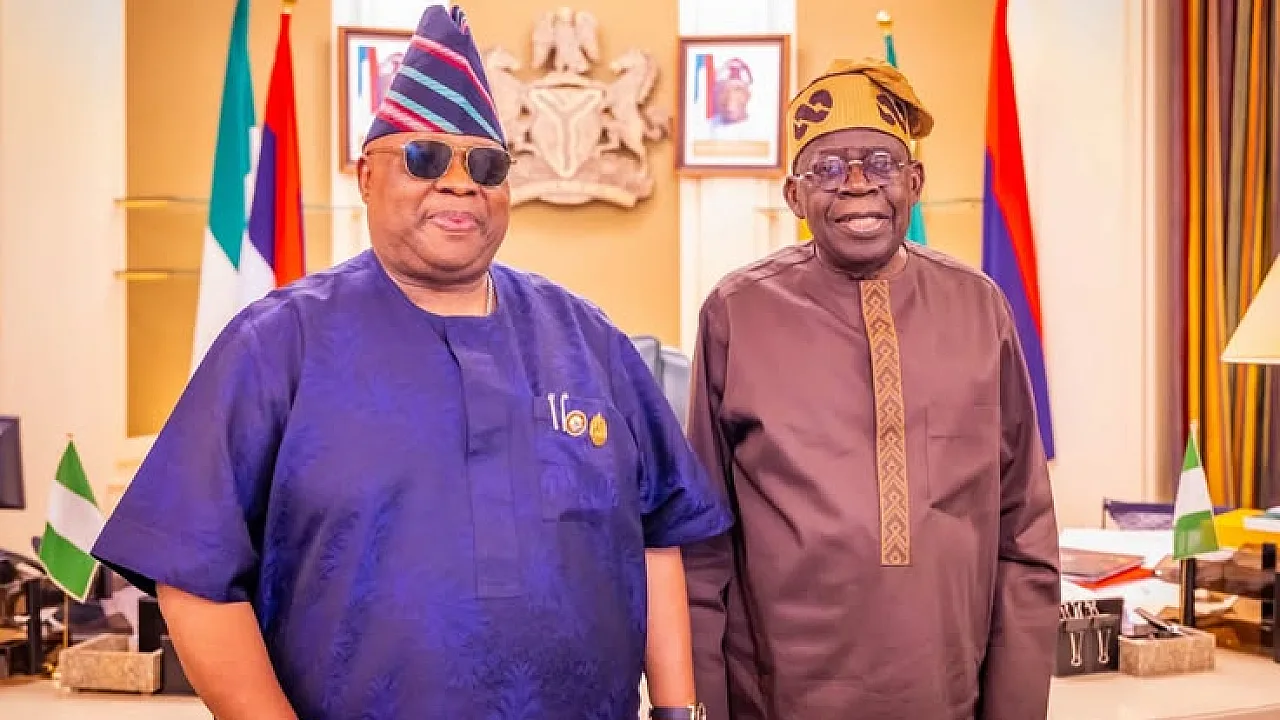
- Understanding Governor Ademola Adeleke’s political choices through the lens of sacrifice, pragmatism and public service.
By Adejare Ayokanmi
I watched the inauguration of President Bola Ahmed Tinubu’s Campaign Council in Abuja few days ago, and one thing stood out to me: the presence of the Governor of Osun State, Senator Ademola Jackson Nurudeen Adeleke, and the attention his appearance attracted.
However, as the programme progressed and the next speaker took the podium, my attention drifted away from the event. My mind travelled back to the events surrounding the last Osun governorship election. I began to reflect on the political battles, the insults, the accusations and the challenges that Governor Adeleke and his supporters endured. I wondered how a man who had been subjected to intense political hostility could appear at such a gathering and publicly express support for the same president whose administration has contributed to his political and administrative difficulties.
For a moment, I found myself questioning his decision to accept the nomination and honour the invitation. But another thought quickly challenged my initial reaction, if he had declined the invitation, would the world have had the opportunity to witness what forgiveness, restraint and political pragmatism can look like when public interest is placed above personal grievances?
That reflection changed my perspective. I began to see the moment not merely as a political appearance, but as an opportunity to consider the difficult choices leaders sometimes have to make when personal convictions, political realities and the welfare of their people intersect.
Shortly afterwards, my phone began to ring. Messages and calls came in from friends who wanted to discuss the governor’s presence at the inauguration and his declaration of support for President Tinubu’s re-election bid. Opinions differed sharply. Some praised him, others criticised him, while many struggled to reconcile his decision with the political experiences of recent months.
As I went online and read the divergent reactions, I encountered a wide range of interpretations. Some viewed his appearance as a demonstration of political maturity; many considered it a sign of weakness or betrayal. Some saw an opportunity for political negotiation, while others expressed disappointment.
My own interpretation was different. I saw the possibility of a difficult sacrifice, one that, in my view, deserves to be examined beyond the immediate emotions of party politics.
It is not always easy to engage with someone you believe has wronged you. It can be even more difficult when you are expected to put aside personal grievances in pursuit of a broader public objective. Yet, leadership sometimes demands decisions that may not immediately satisfy supporters but are intended to create room for negotiation, cooperation and resolve pressing problems.
Forgiveness does not necessarily mean forgetting, and cooperation does not automatically mean surrender. Sometimes, the ability to engage those with whom one has serious disagreements can become a strategic instrument for achieving a greater objective.
That is the lens through which I have chosen to examine the Adeleke family's political journey and its longstanding relationship with the people of Osun State.
To understand the Adeleke political story, one must look beyond the current administration and appreciate the family's history of philanthropy, public engagement and political participation.
I was not born in the days of their father, but those familiar with the late Senator Isiaka Adetunji Adeleke, popularly known as Serubawon, understand why his name continues to occupy a special place in the political history of Osun State. His relationship with the people, his public profile and his political legacy helped establish a connection that extended beyond the usual calculations of electoral politics.
His death could have marked the end of that political chapter. Many might have expected the family to retreat into private life, protect its business interests and abandon the uncertainties of public service.
After all, the Adeleke family has substantial private interests and could, in principle, choose to concentrate on those pursuits without bearing the burdens of political leadership.
Yet, the family's political involvement continued, with other members stepping forward to occupy public space and sustain their relationship with the people.
For many, this represented more than a family's desire to participate in politics. It symbolised a determination to remain involved in the development of Osun State and to offer an alternative to the political order they believed needed to change.
It was a defining moment in the state's political history, one that brought the Adeleke family into sustained confrontation with powerful political interests.
That journey has not been without controversy, setbacks or personal costs. But it has demonstrated that political participation, particularly in a highly competitive environment, often requires resilience and a willingness to withstand pressure.
The Ademola Adeleke political journey has been shaped by several consequential electoral contests, including the 2017 Osun West Senatorial District bye - election, the 2018 governorship election and the 2022 governorship election, which saw him defeat the incumbent governor, Gboyega Oyetola.
Each contest formed part of a broader struggle over political leadership, public confidence and the direction of governance in Osun State.
For their supporters, these experiences reinforced the belief that their political engagement was connected to a wider demand for change. For their opponents, the same events formed part of the normal contestation of a competitive political system.
Whatever your political position is, the intensity of any contests illustrates the enormous pressures that can accompany the pursuit and exercise of political power.
Political campaigns can affect personal relationships, business interests, family security and the ability of public officials to govern without prolonged confrontation. These are realities that should not be dismissed when assessing the choices our leaders make.
It is against this background that I believe Governor Adeleke's latest political decision deserves a more measured examination.
One of the most important lessons I learnt from my mathematics teacher was that many problems can only be solved when you look beyond the bridge represented by the equals sign. If you stop at that point, you may never arrive at the correct answer.
I have come to appreciate that the same principle can apply to politics. Sometimes, the immediate appearance of a decision does not tell the whole story. To understand it, one must examine the circumstances, the available options, the possible consequences and, above all, what the people who stand to gain or lose.
Governor Adeleke's supporters often point to his administration's emphasis on workers' welfare, pension payments, massive infrastructural projects, and social support as evidence of its people-centred approach to governance.
For workers and pensioners, regular salary and pension payments are not mere political statistics. They determine whether their families can afford food, pay school fees, meet medical expenses and live with dignity after years of service. Retirement should be a transition into a period of rest and dignity, not a descent into anxiety and financial hardship.
The Adeleke administration's supporters also point to infrastructural projects and public interventions as signs of progress. The larger point, however, is that public office is not an inheritance to be enjoyed for its own sake. It is a responsibility that should be measured by its impact on the people.
This is why I struggle to understand why every political decision must be interpreted solely through the prism of personal loyalty, resentment or partisan expectations.
If a leader believes that engaging a political opponent could create an opportunity to address an existing problem affecting the people he governs, should that possibility not be considered before his decision is condemned?
One problem that has featured prominently in the political and administrative challenges confronting Osun State is the withholding of local government allocation and the control of the Local Government Secretariats.
For the people, however, the consequences of prolonged institutional disputes can be painfully practical. Local government resources are expected to support essential services, grassroots development and administrative responsibilities. When access to such resources becomes a subject of prolonged controversy, the impact can extend to communities and the delivery of public services.
Governor Adeleke has had to navigate this difficulty while pursuing his administration's agenda. The withheld LG fund has constrained his government's capacity to deliver certain development objectives.
It is therefore understandable that any opportunity to resolve and get access to resources lawfully due to local governments would attract the attention of an administration seeking to deliver more for its people.
The question is not simply whether a political leader should cooperate with another leader. It is whether such engagement can produce lawful and measurable benefits for the people.
The announcement of support for President Tinubu's re-election bid has understandably generated debate, particularly among those who believe that the president has not done well to deserve second term and those who knew that Mr President's political interests have often conflicted with Governor Adeleke's. But political engagement is rarely as straightforward as public emotions suggest.
A governor may disagree with a president on several issues and still recognise the importance of maintaining a working relationship with the Federal Government. The same is true of political leaders across party lines, disagreement does not always eliminate the need for dialogue.
The possibility that a leader choose negotiation over confrontation is not, in itself, evidence of weakness. Nor does cooperation necessarily erase past disagreements. Sometimes, the most difficult political decision is to sit at the same table with someone whose actions has hindered your productivity, but because the people you represent cannot afford an endless cycle of hostility, you have to.
The biblical account of Joseph offers an instructive reflection on forgiveness and responsibility. After being betrayed by his brothers and sold into slavery, Joseph eventually rose to a position of authority. When he later encountered the same brothers who had wronged him, he had the opportunity to retaliate. Instead, he chose a path that ultimately preserved lives and reunited his family.
Joseph's story is not an argument that wrongdoing should be ignored or that accountability is unnecessary. Rather, it illustrates that personal pain does not always have to dictate the choices we make when greater responsibilities are at stake.
For me, this is one of the possible lessons in Governor Adeleke's decision to engage politically with President Tinubu despite the grievances expressed by some of his supporters. Perhaps the governor sees that a working relationship can help address issue of seized Local Government Fund. Perhaps he is making a broader political calculation.
If the guiding objective is to secure tangible benefits for the people, then the decision deserves to be assessed against that objective. A leader who places public responsibility above personal resentment may disappoint those who expect political confrontation. Yet, the true test of that decision will be whether it produces results.
It would be unfair to dismiss the disappointment expressed by some supporters of Governor Adeleke. People who stood by him through difficult political contests may feel that his decision contradicts the expectations they formed from those experiences.
Their concerns also deserve to be heard. Political loyalty is often built on shared experiences, common expectations and a belief that a candidate represents a particular vision. When that candidate makes an unexpected move, supporters naturally seek an explanation.
But loyalty should not require people to abandon critical thinking, just as disappointment should not prevent them from examining the possible consequences of a decision.
The governor owes the people clarity about his political choices and continued commitment to the promises he made to them. His supporters, in turn, have every right to ask whether the engagement will advance the interests of Osun State.
The ultimate measure is not the applause at a political gathering, the reactions on social media or the number of people who condemn or celebrate the decision. It is the substance of the outcome. If the relationship produces meaningful progress, resolves LG crises and improves the welfare of the people, its practical value will become clearer.
As I reflected on the governor's appearance at the inauguration, I also thought about his rendition of "Oluwa Mi Modupe", a song of gratitude to God that turned him to cornerstone in the presence of those that rejected him.
To me, the moment offered an opportunity to reflect on gratitude, endurance and the ability to remain composed amid political uncertainty. Whatever interpretation one places on the song or the occasion, it is a reminder that political life is often shaped by experiences that the public sees only in fragments. What appears to be a simple event may carry different meanings for the people involved and for those observing it from outside.
The people of Osun State deserve a government that continues to pursue development, protects public resources, pays workers and pensioners as and when due, improve heathcare, reduce unemployment, constructs roads, supports vulnerable citizens and transforn the educational standard. They also deserve political leaders who can disagree without allowing personal animosity to become a permanent obstacle to public progress.
As the debate continues, I urge everyone to look beyond the immediate emotions surrounding the Adeleke's political choices. Before condemning the governor, ask what he hopes to achieve through this engagement And before labelling it a betrayal, examine the facts.
The Adeleke's political journey, like that of others involved in public life, should be judged neither solely by its supporters nor exclusively by its opponents. It should be examined through its record, its decisions, its commitments and the measurable impact of its actions on the people.
Governor Adeleke's support for President Tinubu does not, by itself, determine the outcome of the 2027 Presidential election. What it does create is an expectation: that the engagement should yield something meaningful for the people, particularly where longstanding political and administrative disputes remain unresolved.
If the relationship helps secure lawful access to public resources, strengthens grassroots development and enables the government to deliver more effectively, the people of Osun State will have reason to appreciate the outcome.
For me, the central issue is not whether Governor Adeleke has chosen to embrace political cooperation rather than continued confrontation. It is whether that choice will advance the interests of the people he swore an oath to serve. Political pride may satisfy personal emotions, but responsible leadership must ultimately answer to the people.
And that is why, beyond the politics, the personalities and the social media reactions, the question that matters most remains this: *What does this decision mean for the people of Osun State?*
If the people benefit, the engagement will have served a purpose. If they do not, no amount of political symbolism can substitute for the results they deserve.
In the end, the people, not the applause of politicians, not the anger on social media and not the calculations of political parties must remain at the centre of every decision made in their name.
Adejare Ayokanmi
olamideadejare20@gmail.com

Comments (0)
Leave a Comment
No comments yet. Be the first to share your thoughts.