


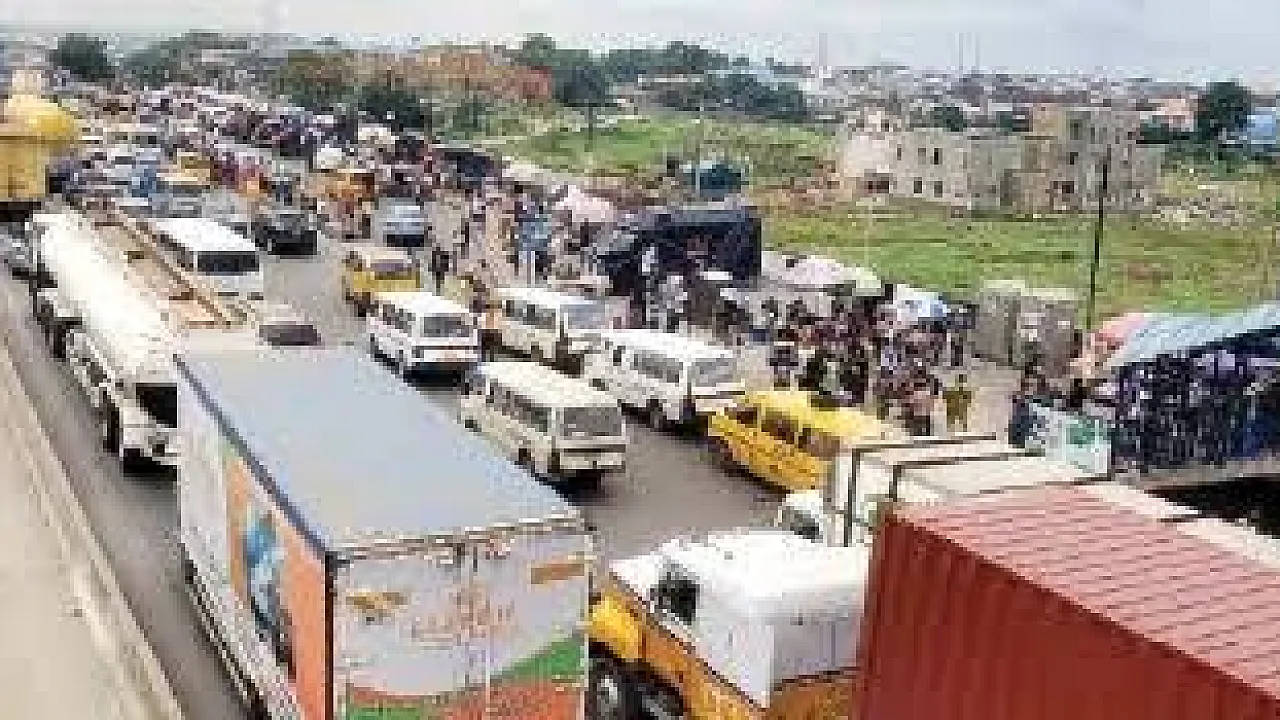
Motorists using the Lagos-Ibadan Expressway are expected to continue facing traffic restrictions around Kara Bridge as the Federal Government proceeds with repairs to damaged expansion joints on the busy bridge.
The rehabilitation began on September 8, 2026, and is scheduled to last about two weeks, with the current official timeline pointing to completion around September 22, subject to construction and operational conditions.
The repairs have already caused severe traffic congestion on several occasions, particularly during peak periods, while accidents and vehicle breakdowns have at times made movement even more difficult.
However, work has progressed.
As of September 15, two of the four lanes involved in the current repair phase had been completed, with newly laid concrete being allowed to cure before traffic is shifted and work begins on the remaining lanes.
Why is Kara Bridge being repaired?
The Federal Ministry of Works says the expansion joints on Kara Bridge have exceeded their service life.
Expansion joints allow sections of a bridge to expand and contract as temperatures change. When they become badly damaged, the structure can be exposed to problems including cracking, buckling and unsafe movement between bridge sections.
Officials also said the deteriorating joints had been linked to accidents around the location, making their replacement necessary.
The repair area itself covers only about 100 metres, but because Kara Bridge carries a huge volume of traffic between Lagos and Ogun State, reducing the available lanes has had effects far beyond the immediate construction zone.
When will Kara Bridge repairs end?
The Federal Government and Ogun State traffic authorities have scheduled the rehabilitation to run from September 8 to September 22, 2026.
Some earlier public advisories referred to September 21 as the expected reopening date, but later Federal Ministry of Works and TRACE information gives September 22 as the scheduled end of the two-week exercise.
Motorists should therefore treat September 22 as the current target rather than a guaranteed reopening time.
The Federal Ministry of Works has said the schedule remains dependent on factors including construction conditions and the time required for newly poured concrete to cure properly.
Is Kara Bridge completely closed?
No.
The bridge has not been completely shut for the entire rehabilitation period.
The work is being carried out in phases, with part of the affected carriageway closed while vehicles are allowed to use the remaining section under controlled traffic arrangements.
This arrangement allows traffic to continue moving, but road capacity is significantly reduced.
That is why relatively small incidents such as a broken-down vehicle or accident can quickly create long queues along the expressway.
What is the latest progress on the repairs?
By September 15, contractors had completed two lanes in the ongoing phase of the expansion-joint work at the Kara Bridge exit towards the OPIC area.
The new concrete must be allowed to dry and harden before vehicles are transferred onto those lanes.
Once that happens, construction will move to the other lanes so the remaining expansion joints can be replaced.
This phased method is intended to keep part of the bridge open throughout the project rather than impose a total closure.
What is the traffic situation at Kara Bridge?
Traffic conditions around Kara Bridge have changed significantly from hour to hour during the repair period.
A serious traffic disruption occurred on September 15 after a container truck lost control and collided with six other vehicles around the bridge.
Emergency officials said seven vehicles were involved, but no death or injury was recorded.
The affected vehicles were later removed from the carriageway and traffic flow was restored.
However, motorists again reported hours-long congestion on Tuesday evening, showing that clearing an accident does not necessarily mean the corridor will remain free-flowing during peak periods while repairs continue.
Motorists should therefore not assume that an earlier report of free-flowing traffic represents the situation several hours later.
Traffic can deteriorate quickly, especially during the morning and evening rush periods.
Alternative routes to avoid Kara Bridge traffic
Traffic authorities have advised motorists who do not need to use the affected section to consider alternative routes.
Travelling from Lagos towards Mowe, Sagamu or Ibadan
Motorists can consider:
- Ikorodu Road to Ikorodu Roundabout, then connect through Sagamu Road or Itokin Road towards Ijebu-Ode
- Ikorodu-Ogijo-Simawa route, before reconnecting with the Lagos-Ibadan Expressway
- Lagos-Abeokuta Expressway through Sango and Ifo, then connect towards the interchange.
Motorists coming through the Ikorodu axis towards Mowe, Sagamu and Ibadan may also consider Shimawa or Mosinmi, depending on their final destination.
Travelling from Lagos Island towards Ibadan
Another suggested option is the Epe-Ijebu Ode corridor, particularly for motorists whose journeys allow them to avoid the Kara-Berger section entirely.
These alternatives may also experience increased traffic because other motorists are diverting onto them.
Drivers should therefore check traffic conditions before beginning their journey.
Why does Kara Bridge traffic affect so much of Lagos?
Kara Bridge is located at a critical point connecting Lagos with communities such as Arepo, Magboro, Ibafo, Mowe and other parts of Ogun State, while also serving motorists travelling farther along the Lagos-Ibadan Expressway.
Thousands of people who work in Lagos but live in Ogun communities use the corridor daily.
When available lanes are reduced at Kara, traffic can therefore build backwards into Lagos.
Earlier during the repair exercise, congestion stretched through Berger, 7Up Junction and towards the Secretariat/Alausa area, with some motorists spending several hours in traffic.
This explains why a relatively short repair section can cause disruption many kilometres away.
What motorists should know before travelling
Until the repairs are completed, motorists using the Lagos-Ibadan Expressway should:
- allow extra travel time
- avoid peak periods where possible
- check current traffic updates before leaving
- obey LASTMA, TRACE, FRSC and police officials around the diversion
- avoid driving against traffic
- ensure vehicles are roadworthy before entering the corridor
- consider alternative routes when congestion becomes severe.
Traffic authorities have also deployed tow trucks around the corridor to remove broken-down vehicles and other obstructions more quickly.
When will traffic return to normal?
If the Federal Government's current timetable is maintained, the expansion-joint repairs should be completed around September 22, 2026.
But completion of construction and a return to completely normal traffic are not necessarily the same thing.
The work involves concrete that must be allowed to cure before traffic can safely use repaired sections, and unexpected issues such as rain, accidents or construction delays can affect the timetable.
For now, motorists should regard September 22 as the scheduled completion date and continue planning for possible delays until authorities announce that all restrictions have been removed.
Frequently Asked Questions
Why is Kara Bridge being repaired?
The Federal Government is replacing damaged and ageing expansion joints that officials say pose safety and structural risks.
When did Kara Bridge repairs start?
The current rehabilitation began on September 8, 2026.
When will Kara Bridge reopen fully?
The current official schedule points to completion around September 22, 2026, although this remains subject to construction conditions.
Is Kara Bridge completely closed?
No. Repairs are being carried out in phases, with traffic allowed through available lanes under controlled movement.
Are there alternative routes?
Yes. Options include the Ikorodu-Ogijo-Simawa corridor, Lagos-Abeokuta Expressway through Sango and Ifo, and Epe-Ijebu Ode route, depending on a motorist's origin and destination.
Was anyone killed in the September 15 Kara Bridge crash?
No. LASEMA said no death or injury was recorded in the seven-vehicle crash. The vehicles were subsequently removed and traffic was restored.

Comments (0)
Leave a Comment
No comments yet. Be the first to share your thoughts.